

How AI is Shaping the Future of the Media Industry
How AI is reshaping media, from production and localization to discovery, advertising and trust, and what media leaders can do now.

Few industries feel the impact of artificial intelligence as directly as media and entertainment. AI now touches every step of the journey from idea to audience: how stories are produced and localized, how audiences discover them, how they are monetized and, increasingly, how they are trusted.
The shift is no longer theoretical. Streamers are putting generative AI shots on screen, leagues are dubbing live commentary into new languages, and answer engines are changing how people find the news. At the same time, regulation, labor agreements and provenance standards are setting the rules of the road. In this post we look at what recent public research says about where AI is creating value in media, where the risks are, and what media organizations can do now.
The numbers behind the shift
The macro picture is one of steady growth with AI as an accelerant. PwC's Global Entertainment & Media Outlook 2025–2029 projects the industry to reach about US$3.5 trillion by 2029, growing at a 3.7% compound annual rate. Advertising is the main growth engine at a 6.1% CAGR, roughly three times faster than consumer spending, with AI-powered targeting and creative playing a central role. PwC also notes that investment in generative AI businesses exceeded US$56 billion in 2024, and that most of AI's impact so far has come from operational efficiency.
Audiences are moving too. The Reuters Institute's Digital News Report 2025 found that 7% of people across markets already use an AI chatbot for news every week, rising to 15% among under-25s. And in the Institute's Journalism, Media and Technology Trends and Predictions 2026, publishers say they expect search referrals to fall sharply as AI answers replace the familiar list of links.
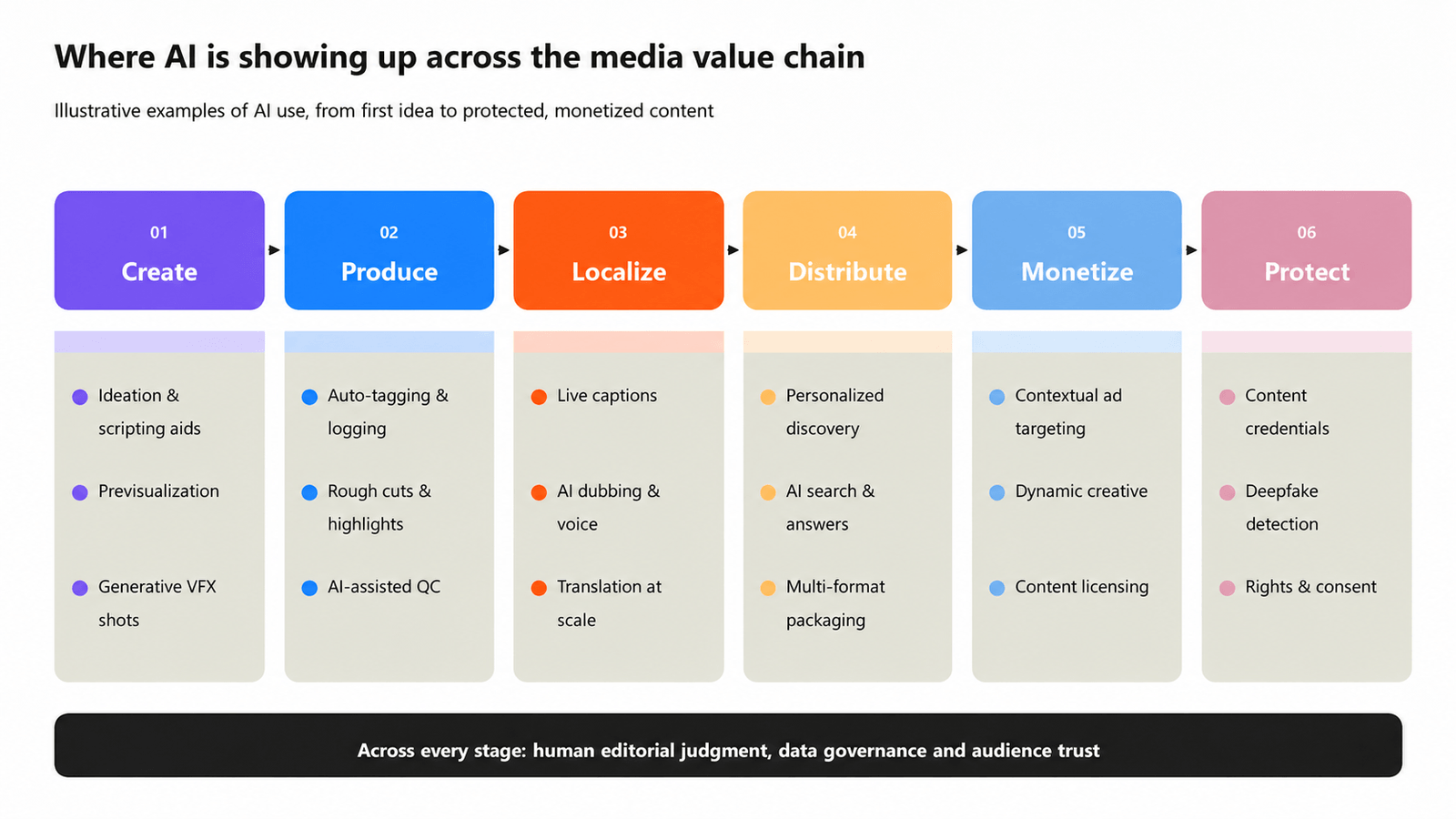
1. Creation and production: from impossible shots to faster workflows
Generative AI has crossed into final on-screen content. In July 2025, Netflix confirmed that its Argentine series El Eternauta (The Eternaut) includes a building-collapse sequence created with generative AI, the company's first such use in an original production. According to co-CEO Ted Sarandos, the sequence was completed about ten times faster than with a traditional VFX workflow, and at a cost that would otherwise not have fit the show's budget.
The bigger opportunity, though, is less visible: previsualization, script and research assistance, automatic logging and tagging of footage, and rough cuts of highlights. These tasks used to consume hours of skilled time, and AI can now give teams a first draft in minutes so that people can focus on creative decisions.
That progress comes with clear expectations from talent. The 2025 SAG-AFTRA Interactive Media Agreement, ratified by 95% of voting members after an 11-month video game strike, requires informed, written consent before creating a performer's digital replica, transparency about how it will be used, and pay for the time spent creating it. Consent and compensation are becoming part of the production pipeline, not an afterthought.
2. Quality control and post-production: AI as a first reviewer
Every recording has to be checked before it is published: black frames, freezes, dead audio, captions out of sync, where the program really starts and ends. Traditional signal analysis can flag potential issues at scale, but it cannot tell whether a still frame is a fault or a deliberate title card. Combining deterministic media analysis with AI that interprets the findings turns a manual, finding-by-finding review into a first pass that an operator confirms rather than performs from scratch.
We described this pattern in detail in How Southworks Built an AI-Powered Quality Control Pipeline for Recorded Live Content on Microsoft Azure: signal processing measures what happened, AI helps interpret what it means, and a person makes the final call.
3. Localization and accessibility: every story, in every language
Localization is where AI's benefits are easiest to see, because it unlocks audiences that were previously too costly to serve:
- AI dubbing of live sport. Poland's top football league, Ekstraklasa, launched AI-dubbed commentary for match highlights, letting fans switch between the original Polish and English with a single click.
- Live captions that know who is speaking. At IBC 2025, captioning providers showed live AI captions that identify speakers such as news anchors and commentators by name.
- AI narration at scale. IBM has worked with the Masters and Wimbledon to generate AI commentary for highlight videos, and Eurovision Sport used an AI voice for recaps between live commentary at the European Athletics Team Championships.
For broadcasters, captions on clips that previously aired on TV are often a compliance requirement as well as an accessibility one, so faster, cheaper captioning directly widens what can be published.
4. Distribution and discovery: the answer-engine shake-up
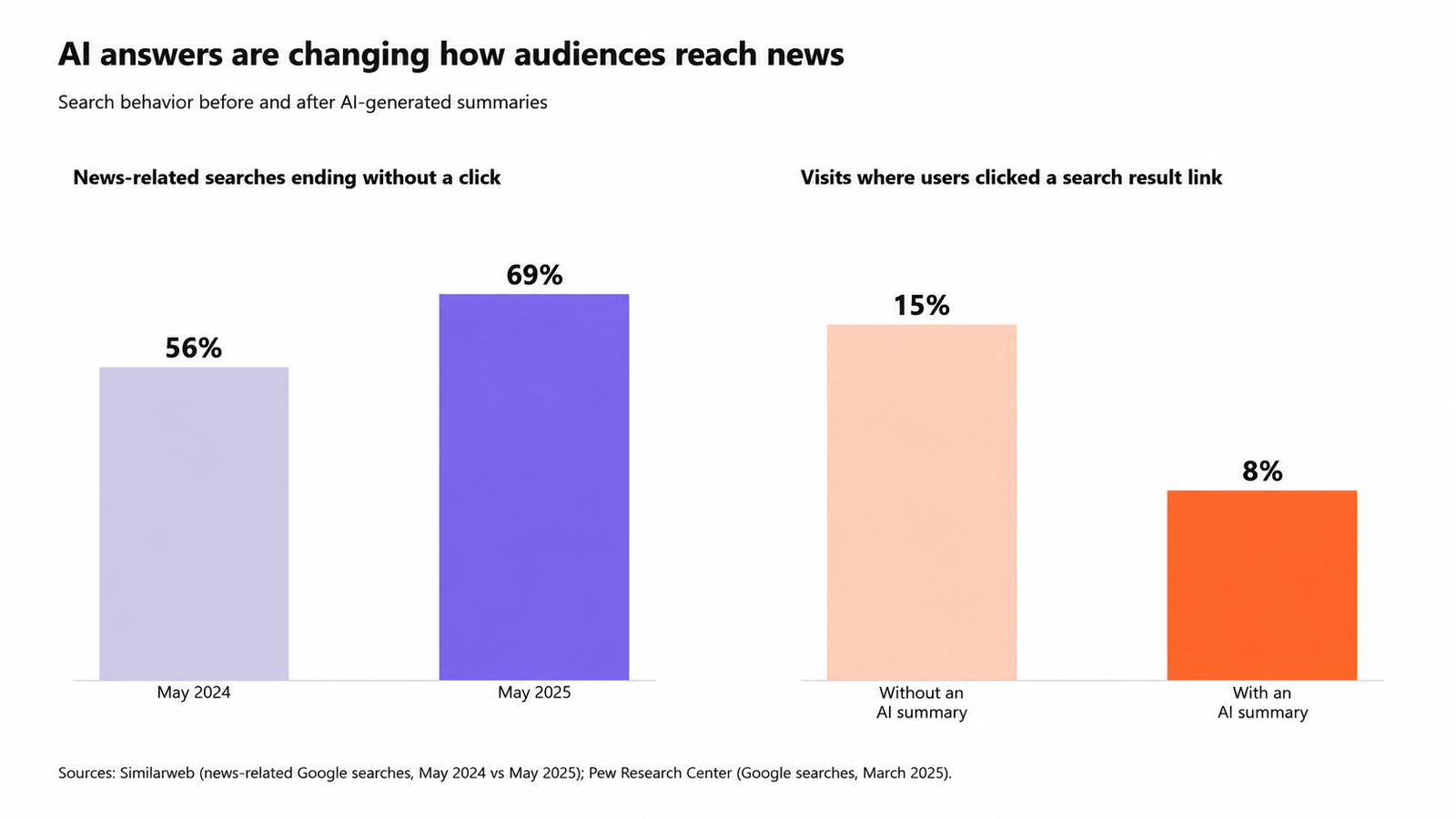
The most disruptive change may be in how audiences find content. When search engines answer questions directly, fewer people click through to the source. Similarweb data shows news-related searches ending without a click rose from 56% in May 2024 to 69% in May 2025, and Pew Research Center found that users clicked a result link in only 8% of visits when an AI summary appeared, versus 15% when it did not.
Publishers are responding on several fronts. Many are licensing their archives to AI companies: The New York Times signed its first AI licensing agreement with Amazon in 2025, reportedly worth US$20–25 million a year, while continuing its copyright lawsuit against OpenAI and Microsoft. Others are investing in direct relationships, distinctive human-led journalism, and more video and audio. The Reuters Institute describes this as making content more “liquid”: one story, packaged by AI into the formats each audience prefers.
Deloitte's 2026 TMT Predictions reinforce the point: daily use of AI inside search is expected to be three times greater than use of any standalone AI tool. For media brands, being discoverable inside AI experiences matters as much as ranking in search once did.
5. Monetization: smarter advertising and new revenue
Advertising is where AI's commercial impact is most direct. PwC sees AI reshaping ad targeting and measurement, with the strongest effects in retail media, social video, mobile and connected TV. Contextual targeting that understands what is happening in a scene, dynamic creative assembled for each audience segment, and automated ad insertion all make inventory more valuable without relying on third-party cookies.
Content itself is also becoming a licensable asset for AI: archives, transcripts and metadata that were once only operational by-products now have value as training and grounding data, provided rights are clear.
Trust is the new competitive advantage
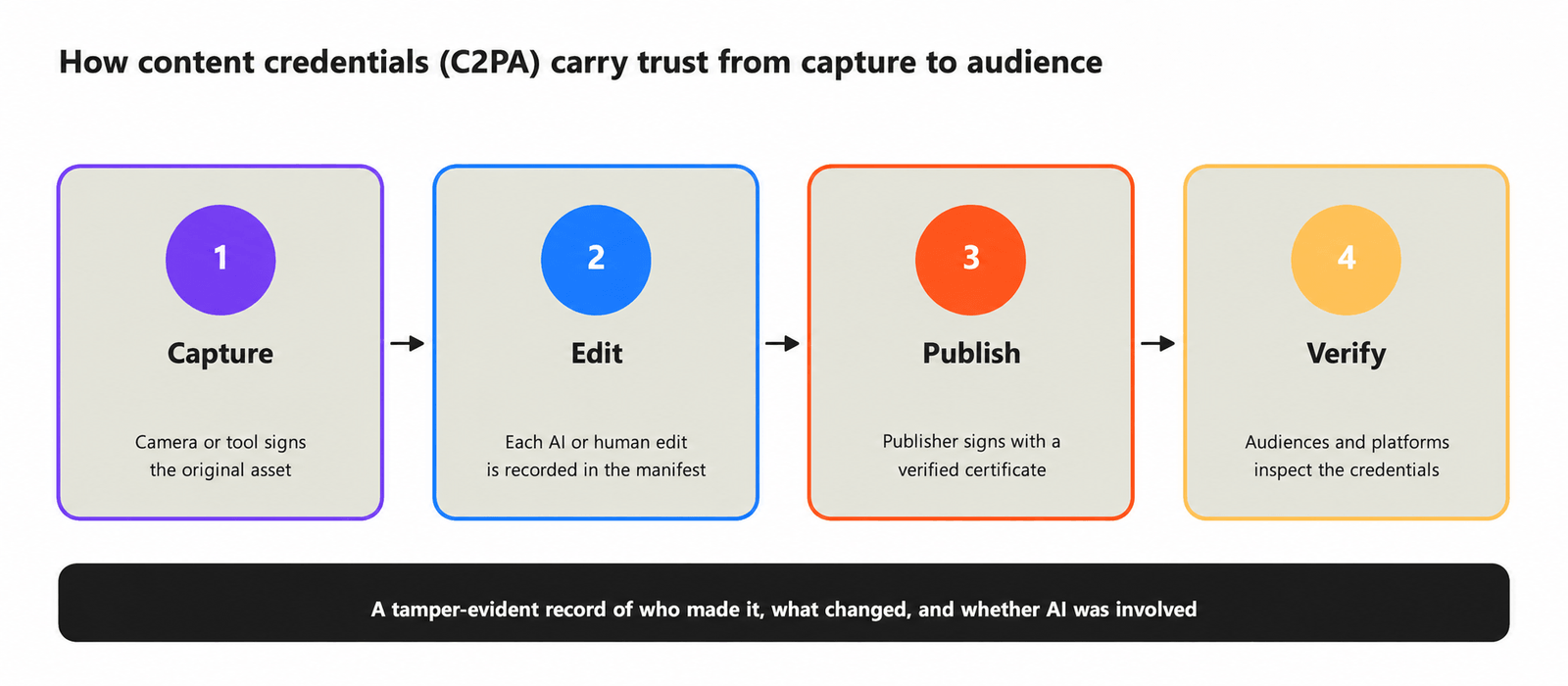
As synthetic content becomes cheap and convincing, the ability to prove what is real becomes a differentiator. The C2PA content credentials standard creates a tamper-evident record of where a piece of content came from and how it was edited, including whether AI was involved. Adoption in news is growing: France Télévisions has started signing its daily news broadcasts, the BBC and CBC/Radio-Canada have taken part in IPTC's verified publisher program, and camera makers including Canon, Leica, Nikon and Sony support credentials at capture.
Regulation is moving in the same direction. Since 2 August 2026, the transparency rules in Article 50 of the EU AI Act require deployers to disclose deepfakes clearly, with lighter, “appropriate” disclosure for artistic, satirical and fictional works, and to label AI-generated text published to inform the public unless it has been through human editorial review. Providers of generative AI systems must also mark outputs in a machine-readable way.
Audiences are asking for the same thing. In the Digital News Report, comfort with news made mostly by AI varies widely, from 11% in the UK to 44% in India, and people generally expect AI-made news to be cheaper and faster but less trustworthy. Media organizations that are open about how they use AI, and keep people accountable for what they publish, will be the ones audiences return to.
What media leaders should do next
- Start where the friction is. Pick workflows with clear, measurable pain, such as quality control, captioning, localization or metadata tagging, and use AI to produce a first draft that people review.
- Keep humans accountable. Design every AI workflow with a named reviewer and clear sign-off. It is good practice, and under the EU AI Act it can also determine what needs to be labeled.
- Build provenance in from the start. Adopt content credentials at capture and preserve them through editing and publishing, so you can prove what is authentic.
- Get your rights and data in order. Know what you own, what you have licensed and what performers have consented to. Clean rights metadata makes both AI use and AI licensing possible.
- Plan for discovery beyond search. Invest in direct audience relationships and in packaging content for the AI experiences where audiences now ask their questions.
How Southworks can help
Southworks works with media and broadcast organizations to bring AI into real production workflows on the cloud, from AI-assisted quality control of live recordings to the media and AI solutions we showcased at NAB Show. Read more in Media + AI: Southworks Highlights from NAB Show 2025 and From Idea to Audience-Ready: Closing the Gap in Modern Media Workflows, or contact us to talk about your own media workflows.
Sources
- PwC Global Entertainment & Media Outlook 2025–2029 (press release)
- Reuters Institute Digital News Report 2025
- Reuters Institute, Journalism, Media and Technology Trends and Predictions 2026
- Deloitte 2026 TMT Predictions
- Columbia Journalism Review on Similarweb zero-click data
- Pew Research Center: Google users are less likely to click on links when an AI summary appears
- Business Standard: Netflix uses generative AI in El Eternauta
- TheWrap: SAG-AFTRA members ratify the Interactive Media Agreement
- Sports Video Group: Verbit's AI captioning at IBC 2025
- TechCrunch: The New York Times and Amazon AI licensing deal
- IPTC: C2PA verified news publishers
- EU AI Act, Article 50 transparency rules (practical guide)