Data is not valuable because you captured it. It becomes valuable when it is curated, trusted, and ready to move — in real time — into the decisions, systems, and AI experiences that need it. That is the problem we solve. That is what Southworks is built for.

AI is a multiplier — and multipliers work in both directions. AI does not fix weak data; it scales whatever is already there. Point it at data that is curated, trusted, timely, and complete, and it amplifies better decisions. Point it at fragmented or stale data, and it amplifies the errors just as fast. For many financial institutions, the underlying architecture remains dangerously fragile.
The cost is not theoretical. Gartner estimates poor data quality drains an average of $12.9 million per organization annually. In capital markets, the damage can compound quickly: a single input error at Citigroup led UK regulators to impose a combined $79 million fine in 2024 for failures rooted in trading systems and controls. And for firms moving into AI, the penalty starts even earlier: Gartner predicts that through 2026, organizations will abandon 60% of AI projects that lack AI-ready data. Bad data does not stay contained. It propagates — turning small defects into systemic, expensive failures.
Yet 83% of investment banks still lack real-time access to transaction data, largely because fragmented systems keep critical information trapped across silos. That leaves firms managing risk, compliance, and competitive decisions on data that is already stale by the time it arrives. The ambition to elevate is there. The investment is growing. But the infrastructure has not kept pace. The result is a persistent gap between the data institutions have and the decisions they need to make: what is happening right now, what will happen next, and what should we do about it? Closing that gap requires more than another AI initiative. It requires real-time pipelines, governed data, and the operating discipline to keep both trustworthy.
Southworks has been solving this exact class of problem in financial services for years — and the credentials are concrete. For Axioma, a leading provider of risk analytics to global institutional asset managers, Southworks replaced batch-based data pipelines with a fully event-driven, cloud-native architecture: real-time ingestion through Azure EventHubs, serverless processing with Azure Functions, automated data quality enforcement, and a production-grade multi-tenant event delivery system that notifies enterprise clients the moment new analytics become available.
For Qontigo, Southworks rebuilt the entire reporting infrastructure from the ground up — replacing manual workflows with a 100% automated, near real-time portfolio intelligence platform governed at the data layer and scaled to serve a global institutional client base.
For a major South American bank, in partnership with Microsoft, Southworks delivered a production-grade Generative AI banking agent in a matter of months — one that understands natural language, correlates transaction data in real time, and set a new benchmark for AI-driven customer operations in Latin America.
What ties these engagements together is not just technical execution— it is the ability to turn complex data platforms and AI capabilities into production-ready business experiences. Across these programs, Southworks has delivered under the constraints financial services demands — latency, accuracy, compliance, and multi-tenant security. That is not surface-level familiarity with the Microsoft stack. It is engineering depth built over more than two decades of delivery.
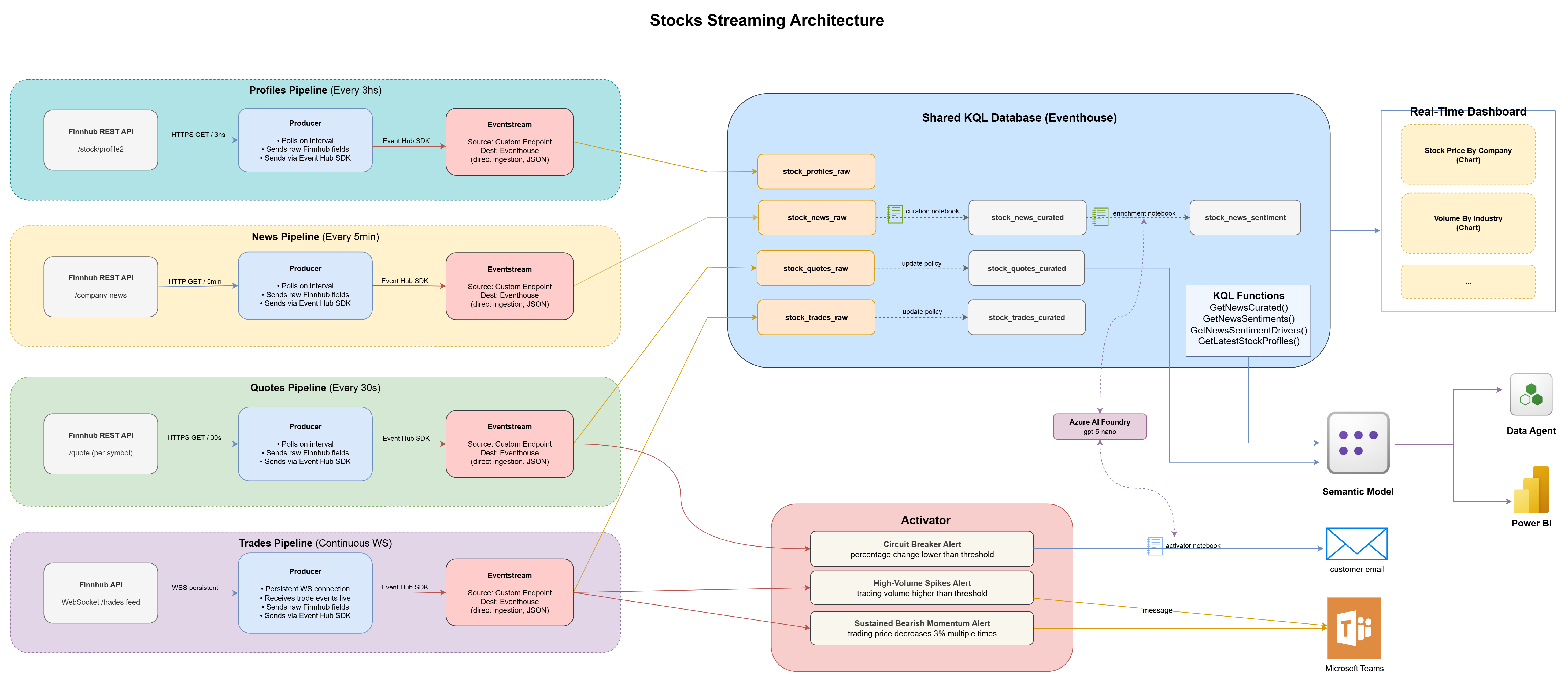
To put Microsoft Fabric's real-time intelligence capabilities to work, Southworks R&D built a stocks streaming implementation that mirrors the demands of live financial market data: continuous ingestion, real-time processing, governed multi-layer storage, and business-facing intelligence — all inside a single Fabric-native architecture. The implementation begins at the source: Fabric Eventstream captures continuous stock price feeds and routes them into Eventhouse, where they can be queried in real time as the market moves. No separate streaming platform. No bolt-on middleware. No context-switching between tools.
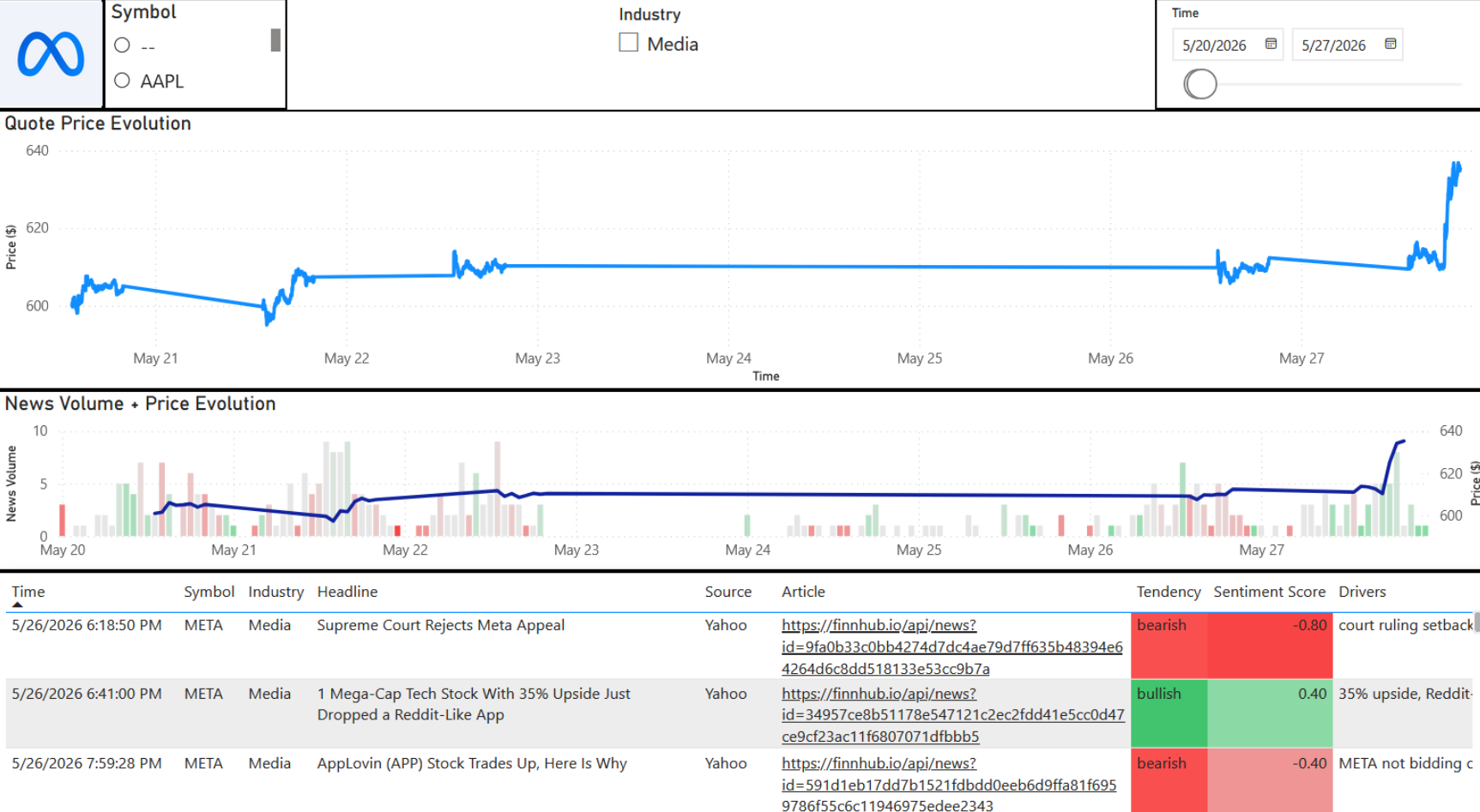
From Eventhouse, data flows into OneLake through a medallion structure — Bronze preserving raw tick-level records, Silver applying cleansing and enrichment rules, Gold serving aggregated, analytics-ready datasets to downstream consumers. This is not an abstract architecture diagram. It is a working implementation, and the results are visible in the screenshots below.
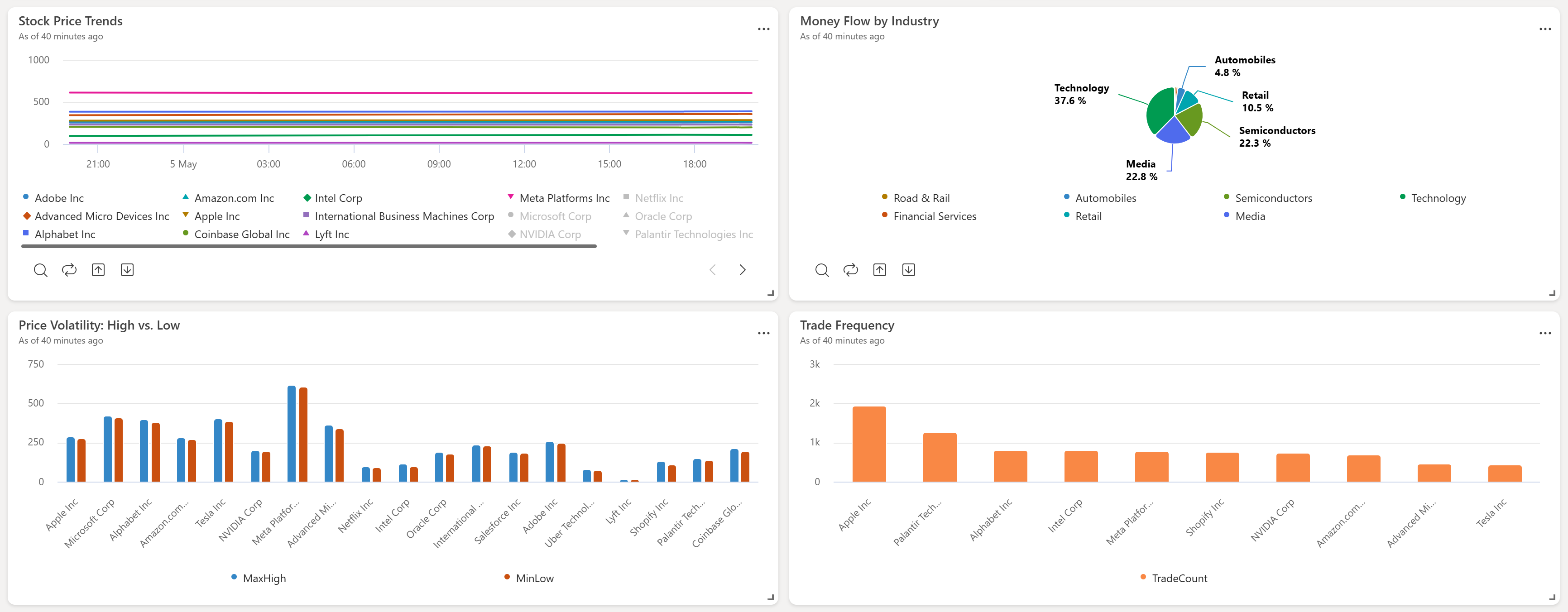
Power BI connects to both the Gold layer and Eventhouse, giving analysts a unified experience over historical trends and live market conditions without rebuilding separate reporting stacks. Fabric IQ adds the semantic layer on top: Microsoft's shared business-context model — the metrics and relationships that let AI agents reason over governed data instead of raw tables — so analysts can explore the same governed, consistent definitions through natural language rather than depending on dashboards or technical intermediaries. That consistency between what a report shows and what an agent answers is exactly what makes natural-language access trustworthy in a financial context. Below, the real-time dashboard makes the operational value immediate: live price movements and analytical views updating continuously as market data flows through the pipeline.
The medallion architecture inside OneLake is equally worth noting. Each layer — Bronze, Silver, Gold — is independently queryable and addressable, meaning teams can iterate on transformation logic, add new enrichment rules, or reprocess historical data without disrupting live consumers downstream. That is the kind of architectural decision that separates a production-grade financial data platform from a prototype that works in a demo.
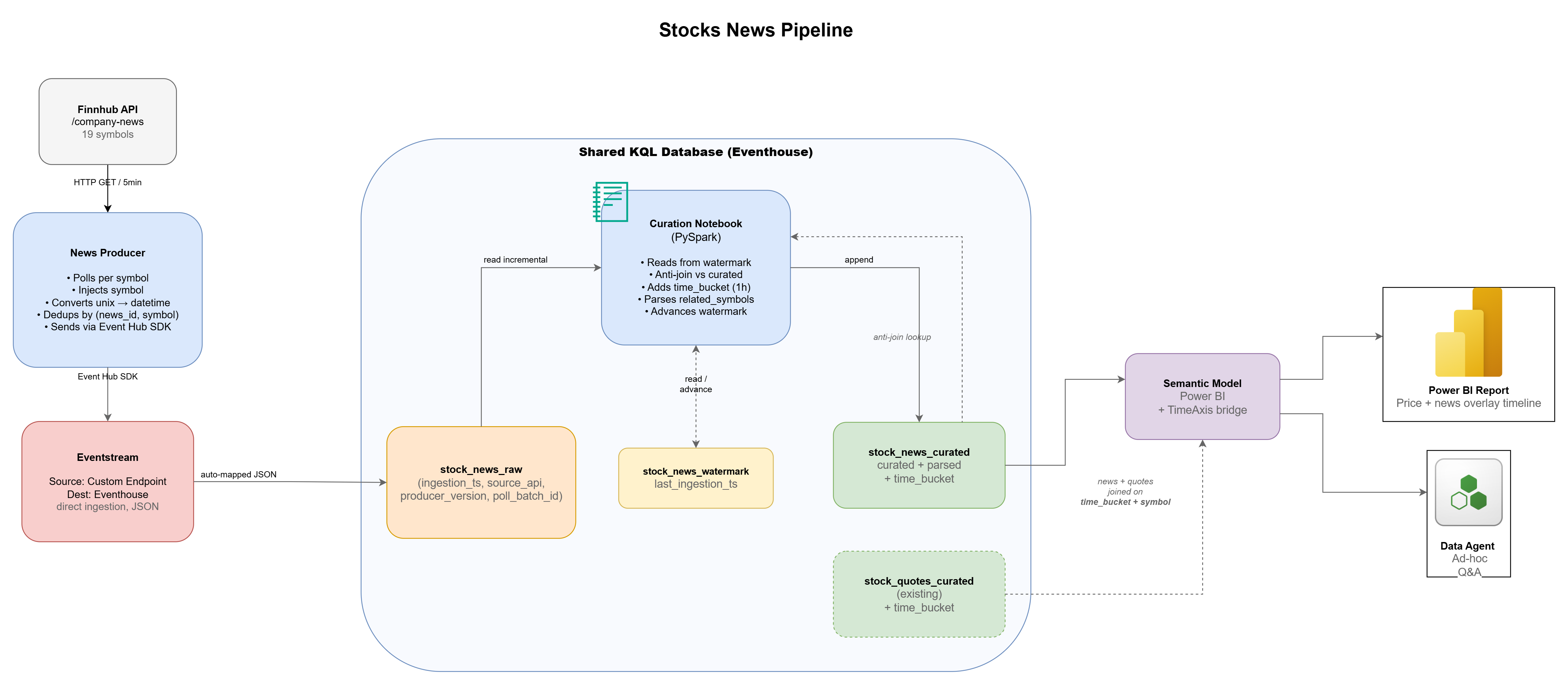
What makes this more than a typical streaming scenario is the kind of decision it supports. In financial markets, the value of real-time data is judged by whether it reaches the people who need it fast enough — and with enough historical context — to act with confidence. In a domain where a delayed or mispriced signal carries immediate cost, that combination of live data and governed history is exactly where a strong foundation proves its worth, and exactly the kind of responsiveness that fragmented, batch-bound data architectures cannot support.
A strong data foundation is not something you build once — it is something you operate. Sources drift, schemas change, and trusted data can quietly degrade into compliance risk or mispriced decisions. That is why Southworks applies a factory-line mindset: using enforceable gates for quality, performance, and completeness as data moves through the medallion layers — from freshness and latency thresholds to coverage and completeness checks and accuracy and drift detection. Agents handle the repetitive work; engineers own the judgment. The result is a foundation that stays continuously validated, observable, and improving with every cycle — keeping AI building on signal, not on noise.
"It doesn't mean doing things with fewer people — it means doing more with the people that you have by enabling them to harness data effectively." Lynn Martin, President, NYSE Group (2024)
That discipline pays off in more than data quality — it changes where your best people spend their time. When automated gates and agents absorb the repetitive, low-judgment work that quietly consumes expert hours — the validation, reconciliation, and continuous monitoring — your subject-matter experts are freed for the work only they can do: interpreting signals, pricing risk, and making the calls that move the business. The goal was never to do the same work with fewer people; it is to point the people you already have at the problems where their expertise compounds. A foundation that effectively operates itself is what makes that shift possible — analysts, engineers, and traders spending their hours on insight and decisions, not on babysitting pipelines.
Financial services is the stress test for any data and AI architecture. The demands are unforgiving: latency must be low, data must be accurate, governance must be traceable, and the system must scale without compromising any of these properties. If an architecture holds up in that environment, it is ready for healthcare, energy, logistics, retail, and every other domain where operational data and AI-driven decisions carry real business consequences. That is precisely why Southworks R&D uses financial data as a validation surface — not because it is a niche, but because it is a proving ground whose lessons transfer readily across industries.
Fragmented data, delayed insight, and the gap between AI ambition and operational reality are not financial-market problems — they are enterprise problems. Microsoft Fabric provides the platform: unified ingestion, real-time intelligence, governed storage, semantic context, and AI-ready architecture. Southworks brings the engineering depth, financial-grade credibility, and production-first delivery model to turn that platform into outcomes — faster, with less risk, and built to last.
--
Thank you to Pablo Costantini, Leandro Martínez, Horacio Monsalvo, and Santiago Moreno for helping build, refine, and bring this implementation to life.
Reach out directly to turn your data into your most powerful competitive advantage. AI only raises the game when the foundation beneath it can hold the weight— and that takes the engineering discipline most organizations still underestimate.