AgriOps showcases how Southworks uses Microsoft Fabric and Fabric IQ to turn fragmented data, real-time signals, ML models, and AI agents into an intelligent operating model for faster decisions, proactive response, and continuously improving business outcomes.
Organizations are entering a new data reality: data is no longer just a source for retrospective reporting; it has become the operating layer for real-time decisions, AI-enabled workflows, and continuous optimization.
AI has raised the bar, but 2026 evidence shows the challenge has shifted from adoption to execution. Gartner forecasts that 40% of enterprise applications will embed task-specific AI agents by the end of 2026, up from less than 5% in 2025 — making trusted data, governance, and operational context critical to real business value.
AgriOps – a Southworks R&D scenario for intelligent farm operations that fully leverages Fabric-native capabilities, and it’s designed to show how real-time telemetry, historical data, ML models, AI agents, dashboards, and natural language access can work together as one operating system– puts that shift into practice by unifying real-time and historical signals, applying ML where prediction matters, embedding AI agents where monitoring and response are needed, and making insights accessible through natural language.
Most organizations are no longer asking whether to use AI; they are trying to make it work reliably inside complex operations. In 2026, that means unifying data, business meaning, governance, and action — not simply adding another AI tool on top of disconnected systems.
Recent 2026 research reinforces the execution gap: one enterprise data and analytics survey found that 99% of leaders still struggle to define consistent business metrics across tools and departments, 87% want more visibility into how AI uses and interprets data, and nearly 80% of data teams spend more than half their time preparing data instead of generating insight.
Microsoft’s 2026 Fabric IQ update frames the same problem from a platform perspective: AI agents and real-time applications need a shared context layer so people and agents operate from a consistent, always-current understanding of the business.
In a scenario like AgriOps, this means real-time telemetry, historical sensor records, financial datasets, weather inputs, ML features, dashboards, alerts, and natural language access must operate as one system. AgriOps was designed to test that pattern: moving from disconnected data and isolated AI experiments to a Fabric-native architecture where data engineering, real-time intelligence, ML, Fabric IQ agents, and business experiences are connected from day one.
Southworks approached AgriOps as an R&D initiative with a clear goal: create a compelling, realistic scenario that applies state-of-the-art data platforms and techniques to connect data, AI, and operational workflows into one coherent architecture for a high-complexity environment.
Agriculture was chosen because it mirrors challenges seen across many industries: distributed operations, real-time telemetry, fragmented history, predictive risk, field-level decisions, and users who need insights without becoming data specialists.
The scenario connects Microsoft Fabric for unified data engineering and analytics, Fabric IQ for AI agents and natural language experiences, Eventhouse for real-time intelligence, OneLake for a governed data foundation, Power BI for decision support, and ML pipelines for predictive intelligence.
Fabric IQ: The Embedded Intelligence Layer
Fabric IQ turns the platform from a passive data repository into an active decision-support system. Microsoft announced Fabric IQ general availability in June 2026, positioning it as the shared context layer for AI agents and real-time applications.
• Operations Agent — an AI-driven monitoring system that continuously evaluates live telemetry against business rules defined in natural language, generating proactive alerts and recommendations without requiring code.
• Data Agent — a natural language interface that allows users to query data across the platform, removing dependency on dashboards or technical intermediaries.
Our Take on Operational ML: Predictive, Explainable, Continuously Learning
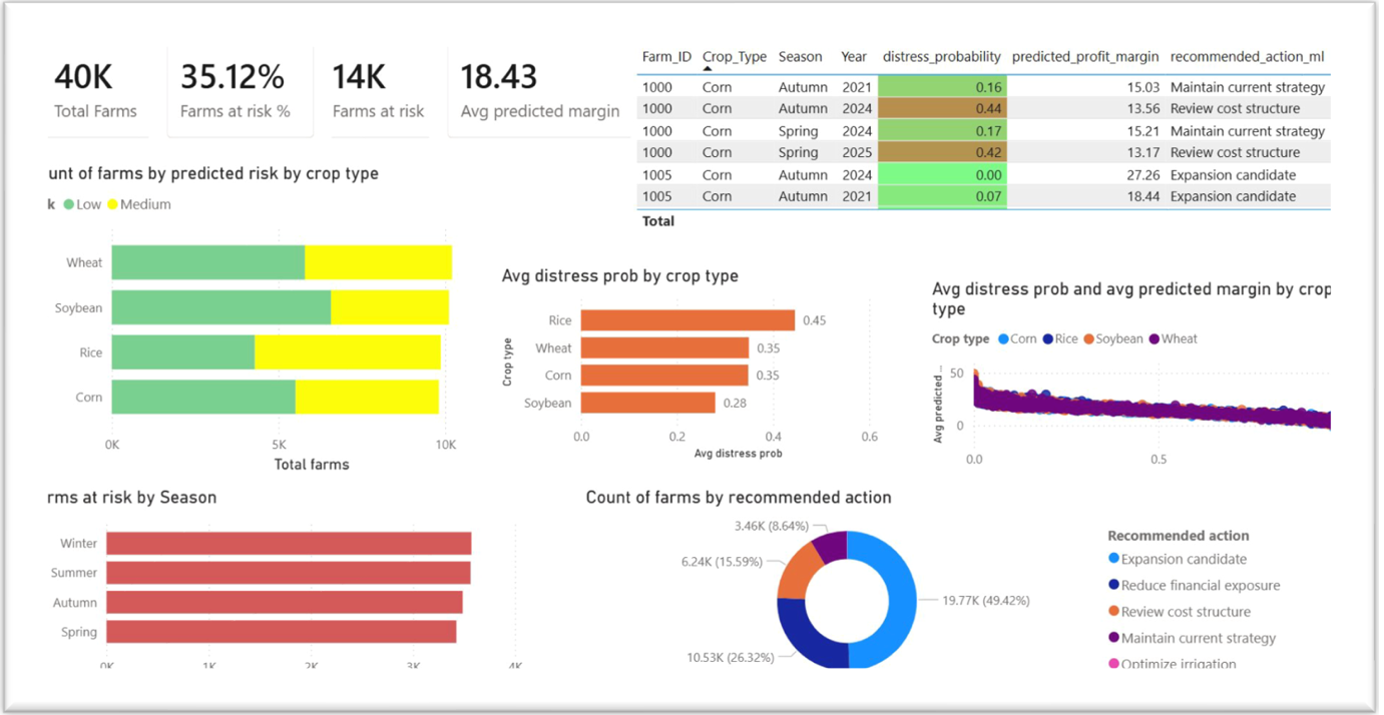
Beyond Fabric IQ, AgriOps uses a closed-loop ML architecture designed for operational decisions. A forward model predicts current-season financial risk using only data available during the season, while a retrospective model evaluates closed financial periods and creates labels for future training. The daily inference pipeline pulls IoT readings from Eventhouse, aggregates them by farm, combines them with the latest known financial data, and produces three outputs: distress flag, expected margin, and risk score. Delta Time Travel compares each farm against the previous day to classify risk as stable, improving, or worsening.
At season end, actual financials feed the retrospective model, new labels are created, and the best- performing models are registered in MLflow. Power BI exposes the outputs through business, model performance, and current-season views — keeping ML traceable, monitored, and connected to operational action.
Model-driven improvements enabled by Fabric
o Engineered 50+ Gold-layer ML features across financial, farm profile, sensor-derived, and climate categories.
o Generated 3 daily predictions per farm: distress flag, expected margin, and risk score.
o Used an 80/20 train-validation split for model training.
o Compared Logistic Regression, Random Forest, and XGBoost across the prediction tasks.
o Exposed ML outputs through 3 Power BI views: business, model performance, and current season.
Operational ML improvements
o Shifted ML from offline experimentation to a daily operational workflow.
o Connected live telemetry, historical financials, and Gold-layer features into one predictive loop.
o Compared each farm against the previous day using Delta Time Travel to detect stable, improving, or worsening risk.
o Registered and versioned the best-performing models in MLflow for traceability.
o Closed the learning loop with retrospective labels that feed the next training cycle.
Why Southworks Is Built for Microsoft Fabric Innovation
AgriOps demonstrates how Southworks turns emerging platform capabilities into practical, production-oriented patterns: ingestion, storage, analytics, AI agents, and ML connected into one operating model where business outcomes drive the technical design.
The platform highlights five practical outcomes that matter beyond the demo:
• AI-driven operations, not just analytics — continuous monitoring and intelligent alerting transform data into immediate action, reducing reliance on manual oversight.
• Embedded intelligence through Fabric IQ — AI agents operate directly on live data, enabling proactive decision-making without custom engineering layers.
• Predictive, self-improving systems — integrated ML pipelines anticipate risk and continuously refine predictions through feedback loops.
• Democratized access to insights — natural language interaction removes technical barriers and enables business users to engage directly with data.
• Accelerated time-to-value — by embedding AI and ML within Fabric, organizations can move from data ingestion to actionable intelligence without building and maintaining complex integration layers.
AgriOps is not just an agricultural scenario; it is a repeatable pattern for data-rich operations that need faster visibility, earlier risk detection, and trusted AI-enabled action.
• Unified operating foundation — real-time, historical, financial, and environmental data connected in one Fabric-native architecture.
• Actionable intelligence — dashboards, alerts, agents, and ML predictions tied to live operational conditions.
• Continuous improvement — retrospective labels, MLflow versioning, and retraining cycles that keep models improving.
• Transferable model — a pattern that can extend to logistics, energy, manufacturing, retail operations, field services, and other complex environments.
Closing Thoughts
AgriOps brings together the core themes behind Southworks’ R&D model: start with a complex real-world scenario, apply Microsoft Fabric capabilities with purpose, and prove how data, AI, and operational workflows can work as one system. The result is a practical showcase of Fabric across ingestion, OneLake, Eventhouse, Medallion architecture, Power BI, Fabric IQ agents, and closed-loop ML — not as isolated tools, but as an integrated foundation for faster insight, proactive response, and continuous improvement.
For organizations modernizing their data estate or operationalizing AI, the lesson is clear: durable impact comes from connecting platform architecture to business execution. AgriOps shows how a Fabric-native approach can move teams beyond experimentation and toward intelligent operations that are governed, explainable, and ready to scale.
Finally, I’d like to wrap up this post by thanking the team that participated in this initiative — Facundo Báez, Carolina Bruscantini, Derek Fernández, Alejo Galetto, and Vanesa Oshiro — for their collective contribution in shaping the scenario, validating what is possible, and exploring how to leverage Fabric IQ to its fullest.